+86 18578756148


An Air Filter can look identical to another on a product page, yet perform very differently inside a real ventilation system. A buyer comparing suppliers across borders must look beyond price and marketing claims. Filter dimensions, efficiency ratings, pressure drop, materials, and replacement availability all affect the final result. Small details matter. A frame that is only a few millimeters too deep may not fit the housing.
ASHRAE Fellow and indoor-air-quality researcher Dr. William P. Bahnfleth has long emphasized evaluating filtration as part of the wider air system. A practical summary of that system-focused guidance is: “Choose a filter your system can use effectively, not merely one with the highest rating.” This is an editorial summary, not a verbatim quotation. It points to a common buying mistake: selecting high efficiency without checking airflow, fan capacity, or operating cost.
The ten tips ahead give global buyers a practical way to assess suppliers and compare offers. They cover application needs, test documentation, filter construction, sizing, energy use, service life, and logistics. Ask for evidence. Check the fine print. A clear test report is more useful than a bold claim on a carton. Buyers should also confirm that quoted performance applies to the exact model they will receive, rather than a similar product in the same range.
No checklist removes every uncertainty. Supplier data can be incomplete, and real-world conditions vary. That deserves a second look. Use these tips to ask sharper questions, flag weak assumptions, and choose an Air Filter suited to the system, site, and maintenance plan.

Identify the contaminant before choosing a filter. A pleated panel filter suits many HVAC systems, where dust and pollen control matter. Bag filters offer greater media area and are common in commercial systems with higher airflow needs. Check the unit’s dimensions and rated airflow; a filter that fits poorly can let particles bypass its media. Fit matters.
For finer particles, compare MERV ratings using ASHRAE Standard 52.2 test results. Under this standard, MERV 13 filters must capture at least 50% of particles from 0.3 to 1 micrometer, and at least 85% from 1 to 3 micrometers. These figures describe test performance, not guaranteed results in every installed system. HEPA filters are a different option: the U.S. Department of Energy defines HEPA performance as removing at least 99.97% of 0.3-micrometer particles under specified test conditions. They may need compatible equipment because dense media can restrict airflow. For odors and some gases, activated carbon media can help, but it does not replace particle filtration. A common buying mistake is selecting the highest rating without checking fan capacity or pressure drop. I would verify both before ordering.
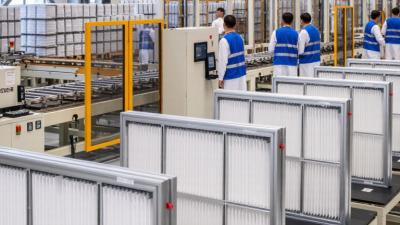
EN 1822 high-efficiency filter classes are defined by their minimum overall efficiency at the most penetrating particle size (MPPS).
How to use this chart: Use the class as a starting point when comparing high-efficiency filters. Actual system performance also depends on airflow, pressure drop, installation, and application requirements; confirm suitability with the filter specification and relevant standards.
Before comparing air filters, identify what must be removed from the air. A workshop producing fine sanding dust needs a different solution from a kitchen handling oil mist. For particles, note their likely size, concentration, and whether they are dry, sticky, or fibrous. For odors or vapors, check whether the process needs a suitable gas-phase media; a particle filter alone may not address them. Small details matter.
Then describe the operating conditions as they actually occur, not just as listed on a facility plan. Record airflow, operating hours, temperature, humidity, and any pressure changes. Check how much dust enters during a busy shift, since sudden loading can shorten service life and raise pressure drop. Measure it first. I would avoid choosing by nominal efficiency alone: the filter must fit the equipment and maintain the required airflow. Ask suppliers for test data relevant to your conditions, and confirm the measurement method. If reliable site data is missing, state that uncertainty and consider a trial with pressure readings and scheduled inspections. Conditions vary, and even a careful estimate can be wrong.
| Buying Dimension | What to Define | Practical Guidance | Example Specification or Data |
|---|---|---|---|
| 1. Contaminant Type | Identify whether the target is dust, pollen, smoke particles, oil mist, microorganisms, or gases and odors. | Choose a filter technology suited to the contaminant. Particle filters do not generally remove gases; gas-phase media such as activated carbon may be needed for certain vapors and odors. | For particulate control, specify the particle-size range or relevant test classification. For odor control, identify the target gas and required service life. |
| 2. Required Air Quality | Set the desired cleanliness level for the room, process, or equipment. | Base the target on the application and applicable local codes or industry standards. A more efficient filter is not automatically the right choice if the system cannot handle its resistance. | Examples of applications include general ventilation, a clean workspace, or a controlled manufacturing process; each may require a different filtration strategy. |
| 3. Filter Rating Standard | Confirm which test method and rating system the supplier uses. | ASHRAE MERV ratings and ISO 16890 ePM classifications use different methods and should not be treated as directly interchangeable. | Under ASHRAE 52.2, MERV 13 has minimum efficiency requirements across three particle-size ranges: 50% for 0.3–1.0 µm, 85% for 1.0–3.0 µm, and 90% for 3.0–10.0 µm. |
| 4. Required Airflow | Determine the design airflow through each filter and the number of filters in the system. | Compare the filter’s rated airflow with the actual system operating point. Undersized filters can increase face velocity and pressure drop. | Record airflow in a stated unit, such as m³/h or CFM, and specify whether the value applies per filter or to the complete bank. |
| 5. Initial Pressure Drop | Set the acceptable clean-filter resistance at the required airflow. | Check the manufacturer’s pressure-drop curve at the actual airflow rather than comparing values measured at different conditions. | Request initial pressure drop in Pa or in. w.g. at the stated airflow; these units describe pressure, not filtration efficiency. |
| 6. Operating Temperature and Humidity | Document normal and peak temperature, relative humidity, and any condensation or washdown exposure. | Confirm that the media, frame, sealant, and gasket are suitable for the complete operating range. Limits vary by construction and must be verified with the supplier. | Provide minimum and maximum operating temperature and humidity, plus any short-duration peaks or wet conditions. |
| 7. Dust Loading and Service Life | Estimate contaminant concentration, operating hours, and expected maintenance interval. | Service life depends on dust type, concentration, airflow, and system operation. Use the specified final resistance or a documented maintenance criterion for replacement. | Ask for recommended final pressure drop and a stated dust-loading test basis where available; avoid relying on a universal replacement interval. |
| 8. Dimensions and Sealing | Measure the filter housing, frame depth, access opening, and gasket or sealing arrangement. | Confirm nominal and actual dimensions, installation orientation, and compatibility with the existing frame. Gaps around a filter can allow bypass air. | Specify width × height × depth in millimetres or inches, plus frame material, gasket location, and any required holding clips. |
| 9. System Compatibility | Check fan capacity, available static pressure, filter-bank layout, and controls. | Evaluate the complete system with the proposed filter’s clean and loaded pressure drop. A higher-resistance filter may reduce airflow if the fan cannot compensate. | Provide the system airflow, available fan static pressure, and existing filter configuration for a compatibility review. |
| 10. Documentation and Supply Needs | Define the required test reports, traceability, packaging, quantity, and delivery conditions. | Request documentation for the stated rating and operating limits. For international orders, confirm dimensions, units, labeling, storage requirements, and replacement availability. | Specify test standard and edition, product dimensions, quantity, packaging requirements, and any destination-specific compliance documents. |
For global buyers, compare test methods before comparing efficiency claims. ASHRAE Standard 52.2 assigns MERV ratings using three particle-size ranges. Its MERV 13 threshold is at least 50% efficiency for 0.3–1 micron particles, 85% for 1–3 microns, and 90% for 3–10 microns. These figures describe laboratory performance, not guaranteed results in every installation. A poorly sealed filter can let air bypass the media. Small gaps matter.
Tip: Match the rating to the actual need. Ask for the complete test report, airflow data, and pressure drop—not just a headline efficiency number. For example, a high-efficiency filter may increase resistance in a system designed for lower pressure drop. Check the equipment specifications before ordering.
ISO 16890 classifies general ventilation filters by particulate matter fractions, including ePM1, ePM2.5, and ePM10. These categories help buyers assess performance against different particle sizes, but ISO and MERV ratings are not direct equivalents. Request certificates or reports that identify the test standard, filter model, and tested configuration. Verify that the document comes from a qualified, independent testing body. Paperwork can look convincing. It still deserves a careful check.
A replacement air filter may look correct and still fit poorly. Measure the existing filter’s length, width, and depth, then compare them with the supplier’s stated dimensions. Check whether those figures describe the actual filter or its nominal size. A difference of a few millimeters can leave gaps around the frame. Look at the gasket, too. A loose seal can let unfiltered air bypass the media.
Tips: Measure the frame in two places. Record the airflow direction. Photograph the label and housing before ordering. These small checks can prevent a frustrating return.
Material choice depends on the air and the system. Fiberglass, pleated synthetic media, and specialty media have different dust-holding and resistance characteristics. Ask for the filter’s efficiency rating and pressure-drop data at your operating airflow. A higher rating is not automatically better if the fan cannot handle the added resistance. Dust type and moisture matter as well. One detail is easy to overlook: a damp location may call for different media and frame construction.
Confirm compatibility with the complete system, not just the filter slot. Check the housing depth, frame style, airflow capacity, and any specified rating requirements. If the equipment manual lists an approved filter size or performance range, use it as a reference. When details conflict, pause and verify with the system supplier. It can feel slower, but guessing is often more expensive.
A filter’s purchase price is only the opening number. Compare total cost per usable airflow, including freight, duties, replacement frequency, and disposal. Ask suppliers for pressure-drop data at your actual operating airflow, not just a headline efficiency rating. A cheaper filter that loads quickly can raise fan energy costs. Get written quotes for sample orders and repeat shipments. Check whether the quoted lead time includes production, inspection, and export packing.
Supplier reliability needs evidence. Request batch traceability, test reports tied to the exact model, and recent delivery references. Confirm who handles defects and replacement freight. Then check import requirements with a customs broker: verify the product classification, country-of-origin documents, labeling rules, and any required conformity paperwork before paying a deposit. Requirements vary by destination. Details matter.
Build realistic freight and buffer-stock allowances into your comparison. A spreadsheet will not predict every delay, and that is worth admitting.