Leave Your Message

What Are the Best Air Filter Manufacturers in China?

Choosing an Air Filter manufacturer in China takes more than comparing prices or browsing polished product photos. Buyers need to examine filter efficiency, pressure drop, frame construction, and the consistency of factory testing. A filter that looks sturdy on a sample table may perform differently after production scales up. Details matter.

Indoor-air-quality researcher Dr. Jeffrey Siegel has emphasized a practical principle: “Filtration should be considered as part of a broader indoor-air-quality strategy.” This is a useful lens for comparing suppliers. A manufacturer may offer HEPA, pocket, or panel filters, yet the right choice depends on the system, target particles, airflow, and maintenance schedule. Ask for test reports, applicable standards, and clear explanations of how results were obtained. Check whether specifications match the product you will receive.

This guide looks at Chinese manufacturers through product range, technical capability, quality controls, customization, and export experience. It also considers communication and after-sales support, which can be easy to overlook until a shipment arrives with unclear documentation. Small warning signs count. No supplier is perfect, and published claims deserve careful checking. The aim is not to crown a single “best” company for every buyer. It is to help readers identify manufacturers that fit their application, verify their claims, and ask sharper questions before placing an order.
What Are the Best Air Filter Manufacturers in China?

What Makes an Air Filter Manufacturer in China the Best?

The best air filter manufacturers in China are judged by more than price and production capacity. They combine tested performance, stable materials, and clear technical records. A reliable manufacturer should explain filtration efficiency, pressure drop, airflow resistance, and service life in practical terms. Vague promises are warning signs.

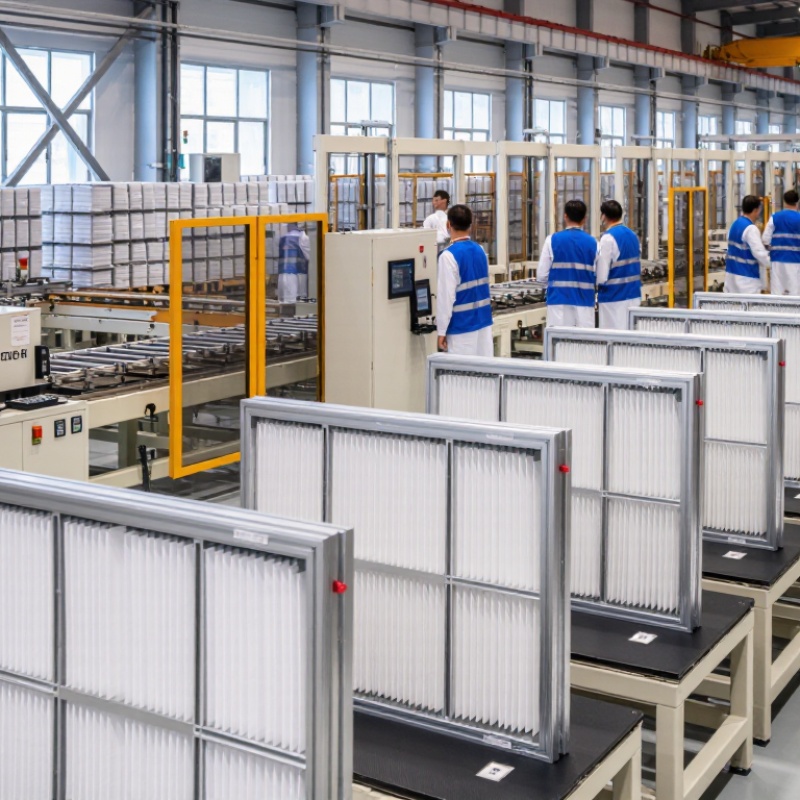
Experience matters on the factory floor. Skilled teams inspect filter media, sealants, frames, and pleat spacing during production. They also maintain batch records, so problems can be traced quickly. Independent laboratory testing adds authority, while recognized quality systems support consistent manufacturing. Still, no factory is perfect. Even a capable supplier may miss a small sealing defect, especially during a busy production period. Regular inspections and honest corrective reports reveal more than polished sales language.

Tips: Ask for recent test reports and sample filters. Compare performance under the same airflow conditions. Check whether the supplier can provide material traceability, inspection photos, and clear replacement guidance. Visit the facility when possible. Notice the details: clean assembly areas, labeled materials, calibrated instruments, and workers who can answer technical questions. A manufacturer should also understand your operating environment, such as dust levels, humidity, temperature, and maintenance habits. The cheapest filter may become expensive when replacement intervals shorten or equipment efficiency falls.
Leading Air Filter Manufacturers in China

Leading air filter manufacturers in China are increasingly judged by testing discipline, not production volume alone. MarketsandMarkets estimates the global air filter market could grow from about USD 15.9 billion in 2024 to USD 22.2 billion by 2029. This expansion is pushing Chinese manufacturers to improve efficiency, traceability, and export compliance.

Strong suppliers usually provide filters tested under ISO 16890 or EN 1822 standards. They should also show pressure-drop curves, particle-capture results, and batch records. The U.S. Environmental Protection Agency reports that indoor pollutant levels can be two to five times higher than outdoor levels. Therefore, filter performance affects both comfort and operational safety. In factory evaluations, a recurring lesson is clear: attractive pricing means little without stable materials, accurate sealing, and repeatable testing. Some suppliers still rely too heavily on catalogue figures. That deserves careful review.

Tip: Request a recent third-party test report, production sample, and replacement schedule. Check whether the factory can maintain the same airflow and efficiency after repeated production runs. Visit the testing area if possible. Ask uncomfortable questions. A serious manufacturer should answer them with data, not promises. Also examine fiber quality, frame strength, gasket compression, and packaging protection. These small details often decide whether a filter performs well in a clean room, hospital, office, or industrial plant.

Key Products and Technologies Offered by Chinese Manufacturers

What Are the Best Air Filter Manufacturers in China?

Chinese air filter manufacturers produce a wide range of products for homes, factories, hospitals, and commercial buildings. Common options include panel filters, pleated filters, bag filters, cartridge filters, HEPA filters, and activated carbon filters. Many factories also make customized frames from galvanized steel, aluminum, stainless steel, or molded plastic. Dimensions can match existing air-handling units, which helps reduce installation changes.

Their main technologies include melt-blown synthetic media, fiberglass media, electret charging, and PTFE membrane filtration. Some manufacturers use automated pleating and ultrasonic sealing to improve consistency. Others provide multi-layer filters for dust, smoke, and chemical odors. Factory testing may measure airflow resistance, particle removal, pressure drop, and leakage. Buyers should request test reports based on recognized standards, such as ISO 16890 or EN 1822, instead of trusting efficiency numbers alone.

A serious supplier should explain how media, frame design, gasket quality, and airflow affect service life. Small details matter. A weak seal can damage real performance. I have also found that catalog data may look stronger than practical results. This is where careful sampling becomes necessary. Ask for batch records, laboratory methods, and replacement intervals under similar operating conditions. No filter lasts forever, especially in dusty workshops or humid coastal areas. Chinese manufacturers can offer strong engineering and flexible production, but quality still depends on process control and honest technical communication.

Quality Standards and Certifications to Evaluate

Choosing an air filter manufacturer in China requires more than comparing prices or glossy certificates. The 2023 World Air Quality Report found that 124 of 134 countries exceeded the WHO annual PM2.5 guideline of 5 μg/m³. This pressure makes verified filtration performance essential. Ask whether the factory tests filters under ISO 16890, which reports ePM1, ePM2.5, and ePM10 efficiency. For high-efficiency products, EN 1822 testing should identify the most penetrating particle size and confirm EPA, HEPA, or ULPA performance.

Look for ISO 9001 certification, but inspect its scope and renewal date. A general quality certificate does not prove every filter meets its advertised rating. Request reports from a CNAS-accredited laboratory, including airflow, pressure drop, dust-holding capacity, and leakage results. ASHRAE Standard 52.2 and MERV ratings can support comparisons, especially for ventilation projects using international specifications. Check whether each report matches the exact model, media, frame, and sealant you will receive. Small changes matter.

I would also review factory records personally when possible. Examine batch labels, incoming-material checks, pleat spacing, and final inspection procedures. Certifications can be genuine yet incomplete. One weakness in my own checklist is relying too heavily on laboratory data. Field installation, humidity, and maintenance may reduce real performance. The manufacturer should explain those limitations clearly, not hide behind a certificate.

What Are the Best Air Filter Manufacturers in China? — Quality Standards and Certifications to Evaluate
Evaluation Area Relevant Standard or Certification What It Covers Evidence to Request How to Evaluate It
General ventilation filter performance ISO 16890 series Classification and testing of air filters used in general ventilation. Filter efficiency is reported in relation to particulate-matter size fractions, including ePM1, ePM2.5, ePM10, and Coarse. A complete test report identifying the tested filter model, dimensions, airflow, pressure drop, fractional efficiency, conditioning procedure, and classification. Check that the report covers the exact product configuration being purchased. Compare efficiency and initial pressure drop at the same airflow and test conditions.
HEPA and ULPA filter performance ISO 29463 series Classification, testing, and marking of high-efficiency and ultra-low-penetration air filters. Testing includes performance at the most penetrating particle size (MPPS). Product-specific classification and test reports, including MPPS efficiency and, where applicable, scan-test or leakage-test results. Confirm the stated class and test method against the applicable part and edition of the standard. Do not treat ISO 29463 classes as automatically interchangeable with EN 1822 classes.
HEPA filter requirements in China GB/T 13554-2020 China’s national standard for high-efficiency particulate air filters, covering technical requirements, classification, testing, inspection, and related product information. A test report that names GB/T 13554-2020, states the filter class and model, and identifies the laboratory and test date. Check that the report applies to the quoted product and that its classification and test results meet the intended application requirements.
Air filters for ventilation and air conditioning GB/T 14295-2019 China’s national standard for air filters used in ventilation and air-conditioning systems, including product requirements and test methods for covered filter types. Product specifications and test documentation showing the applicable filter type, test conditions, performance results, and standard edition. Verify the standard is relevant to the product category. For international projects, also request results to the specification required by the project or destination market.
Quality management system ISO 9001 A quality-management-system standard for an organization. It is not, by itself, proof that a particular air filter meets a specific efficiency or performance class. A current certificate showing the legal entity, certified site, scope of activities, certificate number, validity dates, and certification body. Check certificate status with the issuing certification body or accreditation directory. Confirm that the scope and site cover the manufacturing operations relevant to the order.
Environmental management system ISO 14001 An environmental-management-system standard for an organization. It does not certify filter efficiency, product safety, or emissions performance. A current certificate with the covered organization, manufacturing site, scope, validity dates, and certification body. Use it as evidence of an environmental-management framework, not as a substitute for product testing or regulatory compliance documents.
European market conformity CE marking, where applicable CE marking indicates a manufacturer’s declaration that a product complies with applicable EU legislation. Whether it applies depends on the product and its intended use; it is not a general air-filter quality grade. The applicable EU legislation, signed Declaration of Conformity, product identification, and supporting technical documentation. Request notified-body details if a specific law requires involvement of a notified body. Do not accept a CE logo alone as proof of compliance. Check that the declaration covers the exact product and identifies the legislation and standards relied upon.
Selection note: Standards and certifications serve different purposes. Verify certificate validity and scope, and match independent, product-specific test reports to the exact model, dimensions, airflow, and application. Requirements can vary by product type and destination market.

How to Choose the Right Chinese Air Filter Manufacturer

Choosing the right Chinese air filter manufacturer requires more than comparing prices. The World Health Organization’s 2022 air quality database found that 99% of people lived in areas exceeding its guideline levels. The U.S. EPA also reports that indoor pollutant levels can be two to five times higher than outdoors. Performance claims deserve careful checking.

Ask for test reports covering filtration efficiency, pressure drop, airflow, and service life. ISO 16890 classifies air filters by particulate performance, while EN 1822 evaluates high-efficiency filters and leakage. A reliable factory should explain its test method clearly. Request production samples from the same material batch used for your order. Inspect pleat spacing, frame sealing, adhesive lines, and label traceability. Small gaps can create large failures.

Tips: Review calibration records and recent inspection reports. Check whether the factory controls filter media, cutting, assembly, and final testing internally. Compare pressure drop at the same airflow, not just efficiency percentages. Ask about replacement lead times and packaging for humid shipping routes. A low quotation may hide thinner media or weaker frames. No checklist is perfect. I would also order a pilot batch and test it in the actual HVAC system before scaling up.