Top Boom Cylinder Manufacturers for Global Buyers
Global equipment buyers are paying closer attention to hydraulic reliability, delivery capacity, and lifecycle cost. The global hydraulic cylinders market reflects this demand. Grand View Research estimates that the market reached approximately USD 14 billion in 2023, with steady growth expected through 2030. MarketsandMarkets reports similar expansion, driven by construction machinery, agriculture, mining, and material-handling equipment.
Within this market, the Boom Cylinder remains a critical component. It controls the lifting movement of excavator arms, cranes, loaders, and forestry machines. A single damaged seal can stop a machine in a muddy worksite. That delay may cost far more than the cylinder itself. John S. Cundiff, a recognized fluid-power engineer and author, emphasizes a practical principle: “Component selection must begin with the duty cycle, not the catalogue.” Buyers should therefore examine pressure ratings, bore diameter, stroke length, rod coating, seal design, and tested service life.
This guide reviews leading Boom Cylinder manufacturers serving international customers. It considers engineering capability, production consistency, customization, certifications, warranty support, and export experience. Manufacturer rankings are never permanent. Pricing, lead times, and factory performance can change quickly. Public market reports also use different definitions and regional samples, so their figures should be treated as informed estimates rather than absolute truth. The strongest supplier is not always the largest one. It is the manufacturer that can deliver a correctly engineered cylinder, with traceable quality records, reliable packaging, and technical support after installation.
Boom Cylinder Fundamentals: Force, Stroke, Bore, and Rod-Diameter Data
Top Boom Cylinder Manufacturers for Global Buyers
Boom Cylinder Fundamentals: Force, Stroke, Bore, and Rod-Diameter Data
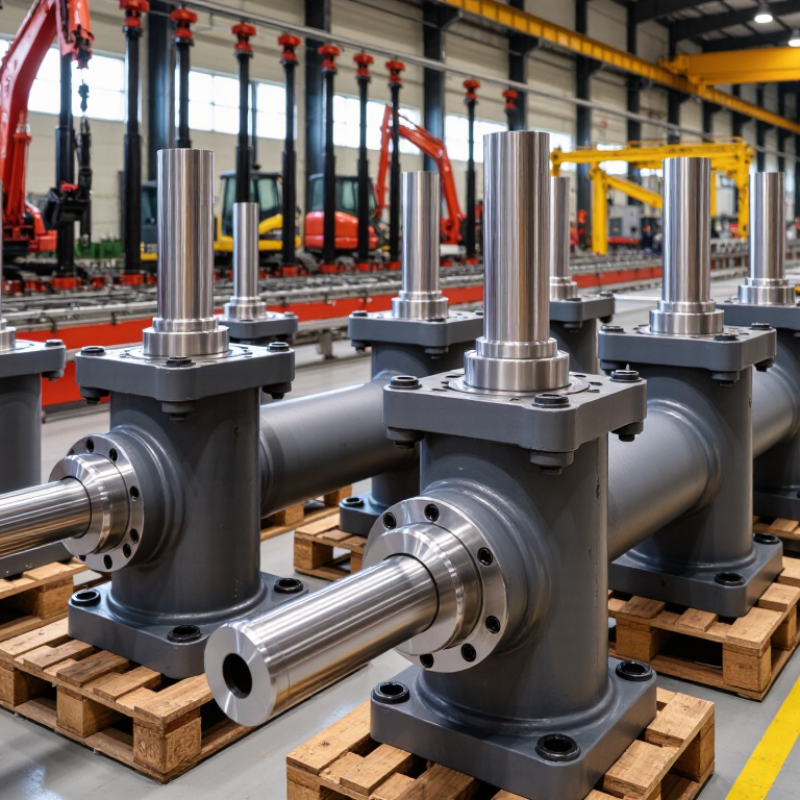
Choosing a boom cylinder starts with force, not catalog appearance. Theoretical force equals hydraulic pressure multiplied by piston area. A larger bore creates more pushing force, but it also increases weight and oil demand. Retraction force is lower because the rod reduces usable piston area. This detail is often overlooked.
Stroke defines the boom’s working reach and movement range. Measure the required pin-to-pin distances at full retraction and extension. Then check the machine’s linkage, mounting angles, and mechanical stops. A cylinder with excessive stroke may damage the boom before reaching its rated travel. Shorter stroke can restrict digging depth. It happens more often than expected.
Rod diameter controls buckling resistance, bending strength, and retraction force. Heavy excavator applications usually need a stronger rod, especially with offset loads or long extensions. However, a larger rod reduces the annular area and may slow retraction under the same flow rate. Specify bore, rod diameter, stroke, rated pressure, and closed length together. Suppliers should provide material certificates, dimensional inspection records, seal specifications, and pressure-test results. Field experience also matters: paint quality can look excellent while pin alignment remains imperfect. Confirm every critical dimension with measured drawings, not assumptions.
Manufacturer Ranking Criteria: ISO 9001, ISO 6020/2 at 160 bar, and ISO 6022 at 250 bar
Top Boom Cylinder Manufacturers for Global Buyers
For global buyers, certification should be tested against operating evidence. The ISO Survey 2022 recorded more than 1.2 million valid ISO 9001 certificates worldwide. That figure covers many industries, not cylinder manufacturers alone. Still, it shows why quality systems matter during supplier screening. ISO 6020/2 defines a 160 bar class, while ISO 6022 covers cylinders rated at 250 bar. Buyers should request certificates, drawing tolerances, pressure-test records, and traceable material documents.
A certificate alone proves little.
Grand View Research’s 2024 hydraulic cylinder analysis estimated the global market at about USD 15 billion in 2023. Growth increases pressure on suppliers to deliver consistent, field-ready products. At 160 bar, inspect rod straightness, sealing performance, and port accuracy. At 250 bar, review fatigue testing, weld quality, surface hardness, and burst margins.
I would also compare cleanliness controls and repair support. These details often decide uptime. One weakness remains: public rankings rarely reveal real failure rates. Buyers may need independent sampling, witnessed tests, and several months of operating feedback. The ranking should reward documented performance, not polished brochures.
Global Buyer Due Diligence: CE, RoHS, Documentation, Lead Times, and Warranty Terms
Global buyers should audit a boom cylinder manufacturer beyond price and catalog photographs. MarketsandMarkets estimated the hydraulic cylinders market at about USD 14.6 billion in 2023, with continued growth driven by construction and mining equipment. That growth increases supplier choices, but not necessarily supplier reliability. Request a current CE Declaration of Conformity, risk assessment, test records, and traceable material certificates. CE is not a quality award. It confirms applicable European requirements were assessed. RoHS evidence also needs attention when electrical sensors, switches, or control components are included. A cylinder alone may not fall under every RoHS category.
Documentation should match the exact model and revision. Check drawings, bore and rod tolerances, seal materials, pressure ratings, welding procedures, and inspection points. Ask for serial-number traceability. One missing page can delay customs clearance or a site audit. In practice, buyers should verify whether certificates come from an accredited laboratory or only from internal inspection. That distinction matters. The 2024 World Bank Logistics Performance Index highlights persistent differences in international shipment reliability, so quoted lead times need written assumptions. Ask for production time, port handling, spare-part availability, and delay remedies separately. A “30-day lead time” may exclude testing and export preparation.
Warranty terms deserve the same scrutiny. Confirm coverage hours, excluded contamination, installation duties, response time, and freight responsibility. ISO 4413 guidance supports documented hydraulic safety practices, but it does not replace supplier-specific testing. Request a sample inspection report before ordering. Some suppliers provide impressive paperwork, yet weak failure analysis. That is worth questioning.

 +86 18578756148
 CONTACT NUMBER
 CONTACT NUMBER
 CONTACT NUMBER

 CONTACT NUMBER